
How to Adjust Your Routine When You Return to the Office
Move one useful routine from a work-from-home day into an office or hybrid week. Check what changed, preserve its purpose, and choose an available opening.
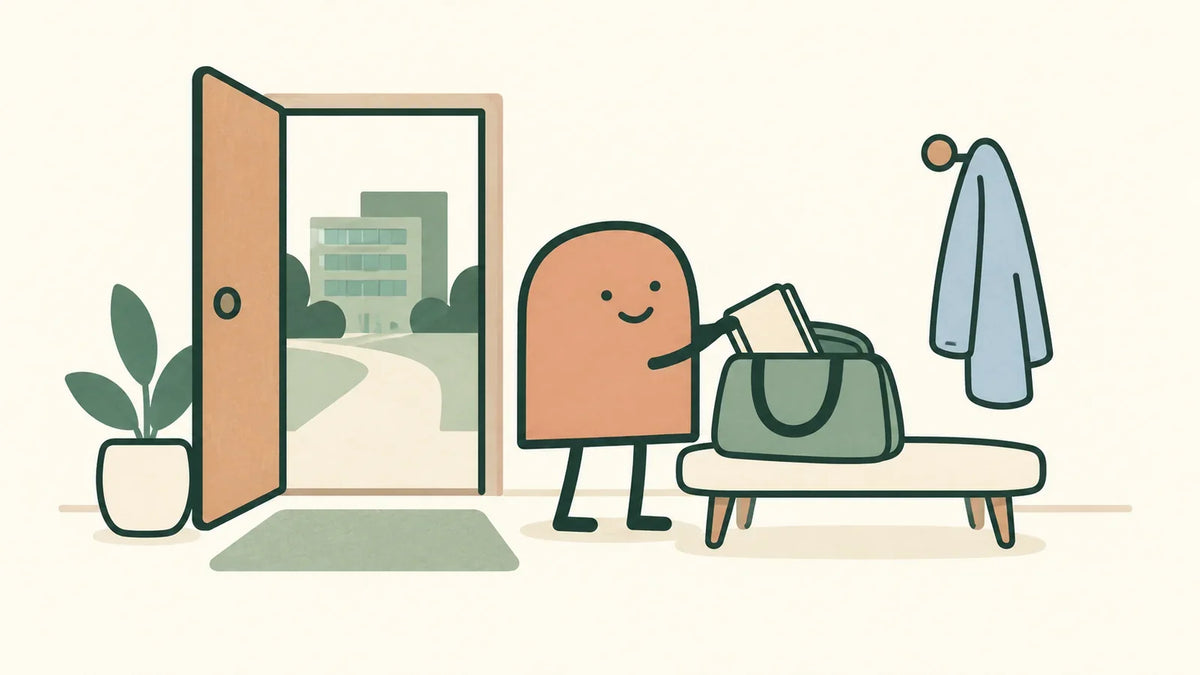
When you return to the office, start by checking which parts of your old routine have lost their time, place, or cue. Keep one useful action, move it to an opportunity available on office days, and set aside extras that no longer fit. A hybrid week can have different arrangements without requiring a different set of goals for every location.
The change can feel larger than the hours spent at a desk. Getting ready, traveling, finding a workspace, and arriving home at a different time can all affect the moments around work. A routine built around being at home may need a new place in that sequence.
Find the opening that disappeared
Choose one familiar routine you want to keep. Write where and when it used to happen, then check what occupies that moment now.
Perhaps you sorted household mail after a home lunch, but lunch now happens at the office. Perhaps you wrote an evening note after closing the laptop, but that transition now leads directly into a commute. The action may still matter even though its old appointment no longer exists.
Use three short lines:
- Before: the old occasion and place.
- Now: what happens at that point on an office day.
- Still useful: the part of the action you want to preserve.
This is a comparison of two real settings. You do not need to rebuild your entire weekly calendar first. If you do need that broader starting map, use the guide to building a routine around a full workweek.
Give office days their actual boundaries
Look at the time you leave home, the travel involved, work commitments, and what must happen when you return. Use the commute you normally experience rather than the quickest trip you have ever made.
Leave room for the ordinary transitions within that day. An appointment that ends at 5:00 p.m. and a bus that leaves at 5:05 do not automatically leave a five-minute habit window. You may still need to pack up and reach the stop.
Do not assume that every former at-home task should move into the evening. Moving six small tasks can create a large new demand after work. Choose the one that matters for your current priority and decide which optional tasks can wait.
Where the change affects shared responsibilities, agree who handles what and when. A longer commute does not automatically transfer all the organizing work to one person. Some problems require a household or workplace arrangement rather than a more detailed personal routine.
Keep the purpose; change the arrangement
Inspect one variable at a time: the cue, location, materials, size, or relevant days. Which part of the previous plan conflicts with the new setting?
| What changed | A practical question |
|---|---|
| You are away from home at the former cue. | Is there a suitable home occasion on another day? |
| Your equipment moves between locations. | What can travel with you without adding a complicated packing system? |
| The evening window is shorter. | What is the smaller useful action, or should this be a different day's task? |
| Office days vary from week to week. | Can the plan apply to a day type instead of a fixed weekday? |
These are options to consider, not extra tasks to adopt. If moving the action would make another crowded part of the day harder, setting it aside temporarily is also available.
A hybrid-week example with one priority
This example is fictional and demonstrates planning choices, not a reader's results.
Devon's chosen priority is keeping household paperwork manageable. While working from home, Devon sorts the kitchen paper tray for ten minutes after lunch on Tuesday. Tuesday is now an office day, so that cue no longer offers access to the tray.
Devon considers moving the session to Tuesday evening. That evening already includes the commute and a shared household commitment. Instead, Devon chooses the same short session after lunch on Friday, a planned home day with a suitable opening.
There is still one paperwork action. Devon has not added a second routine for the office or committed to catching up every night. If Friday later becomes an office day too, the plan needs another decision; a label in the calendar cannot preserve an opportunity that has disappeared.
This example illustrates a genuine move. For a routine that must occur at both locations, such as a short work-closing note, you might instead keep one cue and use a portable note. Choose the arrangement that serves your action rather than copying both examples.
Prepare one repeated transition
Returning to the office can reveal small preparation problems: a pass left in another bag, a needed item kept at the wrong desk, or uncertainty about tomorrow's first commitment. Address a problem you have actually noticed before adding a full preparation checklist.
For mornings, start with one recurring scramble. For the end of the day, a bounded evening closing step can give one unfinished item a place to wait.
Keep food storage, work security, and shared-space requirements intact when moving items between locations. The routine should fit those requirements, not depend on skipping them.
Review after you have experienced the new arrangement
After the next few relevant days, ask whether the new occasion was available and the action still served its purpose. Notice office and home days separately if they presented different conditions. You do not need a perfect first week to learn that one slot was unrealistic.
Change the feature you can name. If the window was shorter than expected, use a smaller version or choose a different occasion. If an employer requirement or caregiving arrangement is the binding constraint, acknowledge it as such. Personal planning cannot remove every external demand.
Bring one useful routine into the week you have now
You do not need to recreate your work-from-home day at a different address. Choose one action worth keeping and give it a realistic place in the changed week.
One Thing at a Time connects that choice with observation, planning, smaller versions, and review. The full method is in the book. Private companion articles are being developed for deeper applications and practice; access follows the offer shown on the site.
Explore the guide and find a manageable starting point for your new routine.
