How to Choose Your First Habit When Everything Feels Important
Choose a first habit by looking at one difficult moment in your week, the part you can influence, and an action small enough to test.

To choose your first habit, start with one recurring moment you would like to make easier. List two or three actions that could help, then choose the one you can influence and fit into the week ahead. Write down when you will try it and when you will review it. You are choosing a starting point, not deciding everything you will ever work on.
This matters when your list includes meals, movement, evenings, work, and a dozen saved ideas. Every item can sound important. The question is which one deserves a practical test now.
Start with a moment, not a complete life overhaul
Write one sentence about a situation that keeps coming up. Be specific enough that you could recognize it tomorrow.
- “I arrive home and have no idea what is available for dinner.”
- “I finish work with unfinished tasks still open on my screen.”
- “I keep planning a routine that needs more time than I have.”
“I need to be more organized” is understandable, but it does not tell you where to begin. “I decide what to bring for lunch while already leaving the house” gives you a moment to examine. You do not need a perfect explanation of your whole week before you work on that moment.
Use three questions to compare your options
1. Would this action help with something I actually notice?
Choose a reason that belongs to you. An action does not become your best starting point because it appears in someone else's morning routine. If having a usable lunch option would make tomorrow less complicated, that is a concrete reason to try it.
2. Is the action mostly within my control?
You cannot always control when a meeting ends, whether a family member changes plans, or how you feel at a particular hour. You may be able to put tomorrow's first task on a note before closing your computer. Describe the action you will take, rather than the result you hope the whole day will produce.
3. Does it have a place in the coming week?
Check the real requirements: time, space, materials, and other people. A plan that needs an uninterrupted hour deserves a second look if your available moments are short. This is not a judgment about ambition. It is a check that you will have an opportunity to try what you have chosen.
Break a tie with the smaller useful test
If two options pass those questions, choose the one with fewer arrangements to make. Put the other on a “later” list. You are not declaring it unimportant; you are protecting one clear experiment from becoming several half-defined commitments.
For example, “check what I can use for tomorrow's lunch after clearing dinner” is a smaller test than “plan every meal for the month.” It still addresses a real point of difficulty. You can decide later whether a larger planning system would be useful.
An illustrative example: three good ideas, one starting point
The following is an invented example to show the decision process, not a reader testimonial.
Sam wants to organize meals, take more breaks, and create an evening routine. All three seem worthwhile. The recurring problem Sam can describe most clearly is the rushed lunch decision before leaving home.
Sam chooses a brief check after dinner: identify one familiar lunch option and write down anything missing. It fits an existing moment and does not require preparing the whole week. The action is specific enough to try even if tomorrow's schedule changes.
The other ideas stay on a separate list. At the end of the week, Sam will ask whether the evening check made lunch planning clearer and what, if anything, needs adjusting. No result is assumed in advance.
Write a plan you can recognize tomorrow
Complete these four lines in a notebook or a note on your phone:
- The moment I want to improve: name one recurring situation.
- The action I will try: use a visible action verb, such as write, check, place, or prepare.
- My starting cue: name something that already happens in that situation.
- My review: choose an occasion to look at whether the plan fit.
If the action contains “and” several times, check whether you have joined several habits together. You may only need the first useful step. If the cue rarely happens, choose a more dependable opportunity or specify which days the plan applies.
What if you choose the wrong habit?
You can change a starting point after observing it. A review might show that the action fits, needs to be smaller, or addresses a problem that is not your priority anymore. Keep a short note about the decision so you are adjusting deliberately rather than repeatedly starting from a blank page.
Give that first choice somewhere to go
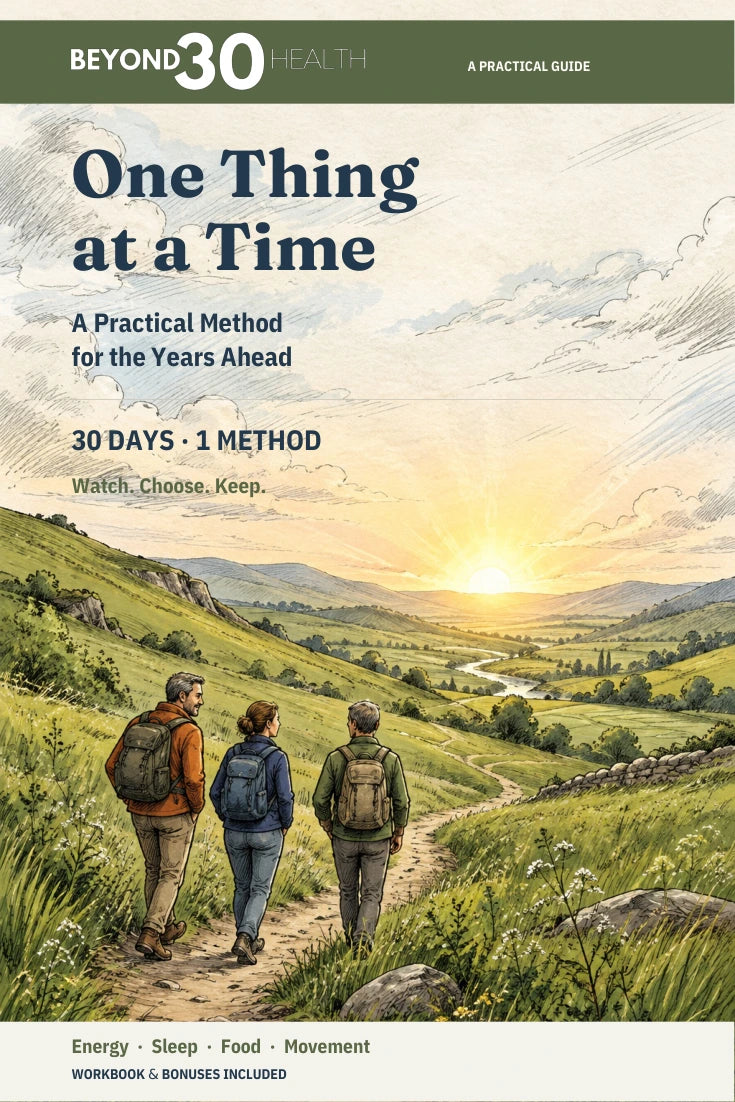
You do not need to solve your entire routine today. If you want a guided place to turn one priority into an action, a smaller version, and a review, One Thing at a Time brings those steps together with reusable worksheets and a 30-day Energy & Method practice path.
Explore the guide and find a starting point that fits your week.