Label Leftovers So You Know What to Use Next
Give leftovers a clear food name and preparation date, keep their storage history visible, and decide what to use or freeze without relying on a smell test.
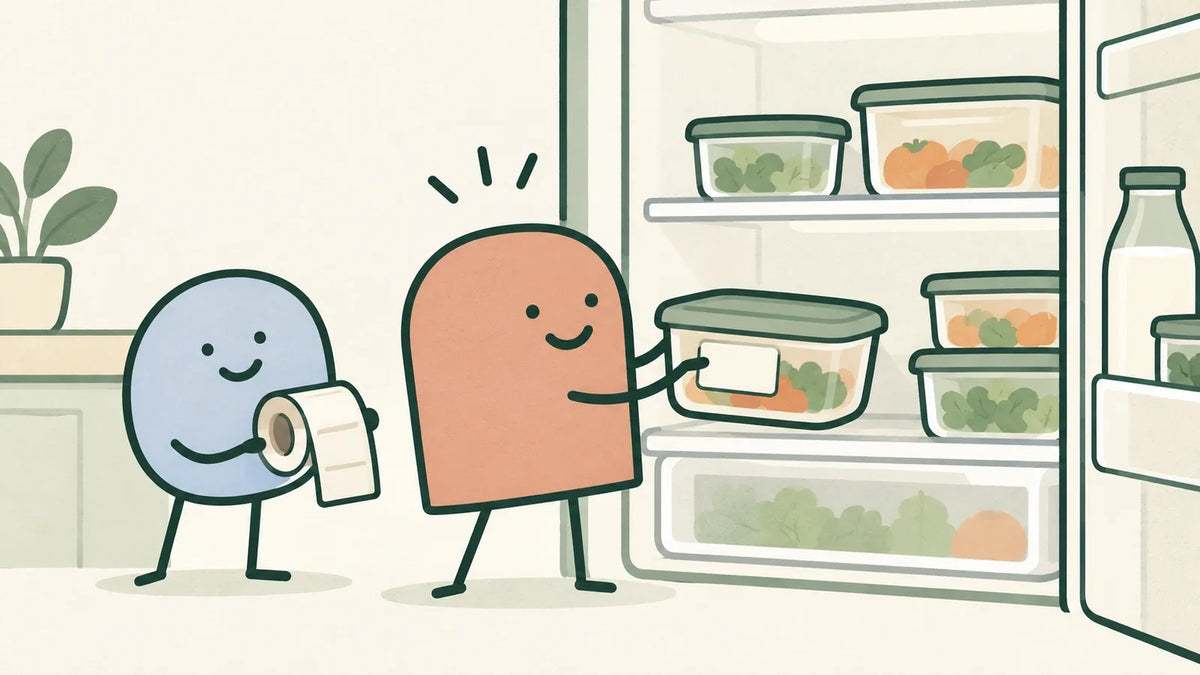
To keep track of leftovers, label the container with the food and the date it was prepared before the date becomes a guess. Keep that history visible when you move or divide the food, then decide what you can use within the relevant storage guidance. A clear label helps organize the decision; it does not make unsafe food safe.
The familiar problem is opening the refrigerator and finding three similar containers. One is from last night, another might be from the weekend, and nobody remembers the third. A better shopping list will not recover that missing history. The useful change happens when the food is first put away.
Write the history, not just the day of the week
Use an ordinary label or suitable tape that works with your container. Write a recognizable food name and a full date, such as “Vegetable soup , cooked October 16.” Add other information when it matters, such as a known freezing date. “Friday” can become ambiguous the following week.
For takeout, record when you obtained it and follow the supplier's instructions and safe-handling guidance. For an opened packaged food, retain or copy the relevant label instructions. Do not assign every item the same homemade-leftovers deadline.
Keep labeling supplies where you can reach them without leaving food out while searching. A special printer or inventory app is optional. The arrangement is useful if the next person opening the refrigerator can understand what the container holds and how old it is.
Match the time window to the actual guidance
USDA's general recommendation is to use refrigerated leftovers within three to four days or freeze them. Health Canada's specific Food safety tips for leftovers page says to eat refrigerated leftovers within two to three days or freeze them. These are different published recommendations, not one universal four-day promise.
Follow the guidance relevant to your location and food, along with any stricter product or individual instructions. The window assumes proper handling and refrigeration. A date alone cannot tell you whether food was cooled appropriately or left out too long.
Keep the original preparation date when food moves into a smaller container. For this simple home system, do not replace it with a newer date after reheating to push the decision further away. Record any later handling separately if useful, rather than making older food look newly prepared.
Make the next decision while there is still time
Ask which of the safely stored leftovers you actually expect to use within the applicable window. Give that food an ordinary place in a coming meal. If you will not use it in time and it is suitable to freeze, freeze it promptly while it is still safely handled, and label the freezing date.
Do not wait for the last possible day simply because the container has a label. Freezing does not rescue food that has already been handled unsafely. If the history is unknown, do not invent a preparation date to make the system look complete.
You can keep the containers you plan to use next easy to see, provided their location remains appropriate for storage. A small, clear arrangement is enough. You do not need to empty the refrigerator or make a display of every leftover.
A fictional example: one container, one decision
This example is invented to illustrate organization, not a report of saved money or reduced waste. Jordan cooks soup on October 16, portions and refrigerates it promptly in shallow containers, and labels each portion with the food and cooking date.
Jordan expects to use one portion the following day. There is no realistic meal planned for the second portion within the local recommended window, so Jordan freezes that portion promptly and records the freezing date. The plan depends on proper handling and suitable storage, not on a promise that every labeled food lasts the same time.
A third container from earlier in the week has no known history. Jordan does not guess a favorable date. The missing information stays missing, and safety takes priority over the wish to use everything.
Keep the safety check separate from the organizing system
Health Canada advises prompt refrigeration in shallow containers, dating leftovers, and not using appearance, smell, or taste to establish safety. It also says to discard cooked food left at room temperature for more than two hours. In hotter conditions, USDA specifies a one-hour limit above 90°F.
When reheating, Health Canada's guidance specifies an internal temperature of 165°F (74°C), checked with a food thermometer, and discarding uneaten leftovers after reheating. Follow the instructions for your food and equipment; a warm surface is not a complete temperature check.
These are handling boundaries, not an invitation to investigate questionable food. When in doubt about safety, discard it. A container can be neatly labeled and still be unsuitable to eat.
Let the labels answer a small question
The question is “What do I have time to use safely?” It differs from checking ingredients before shopping. Once you have made the next use-or-freeze decision, the labeling system has done its job.
One Thing at a Time connects practical food availability with decisions you can make before the busy moment. Explore the complete book for a wider way to choose, plan, and review one useful change without turning the kitchen into another tracking project.
References: Health Canada, Food safety tips for leftovers, updated April 10, 2025; USDA Food Safety and Inspection Service, How do I handle leftovers safely? and Keep Food Safe! Food Safety Basics. Checked October 16, 2026.