Habit Stacking Without Building a Longer Routine
Connect two tasks you already do. Check the order, shared location, and stopping point before turning a useful pair into an overloaded routine.
If habit stacking keeps making your routine longer, try a different question: which two things do you already do that could sit next to each other? Keep the total workload the same, move one existing task beside another, and stop after that pair. You are testing an order, not signing up for a longer list.
Most descriptions of habit stacking focus on attaching a new action to an established one. That can be useful. But if your day already feels full, the practical problem may be scattered tasks rather than missing habits. Reordering what is already there deserves a test of its own.
Count the commitments before you connect them
Write the two actions in plain language. Then ask whether you genuinely do both already. Putting away your keys and putting away the mail may be familiar tasks. Putting away your keys, sorting every receipt, making a budget, and writing tomorrow's priorities is a new routine, even if the list starts with something familiar.
There is nothing automatically wrong with adding a useful action. The point is to notice the difference. A rearrangement changes where work happens. An addition increases what you expect of yourself. Decide which problem you are solving before calling the whole sequence a small change.
Choose a pair that shares a place
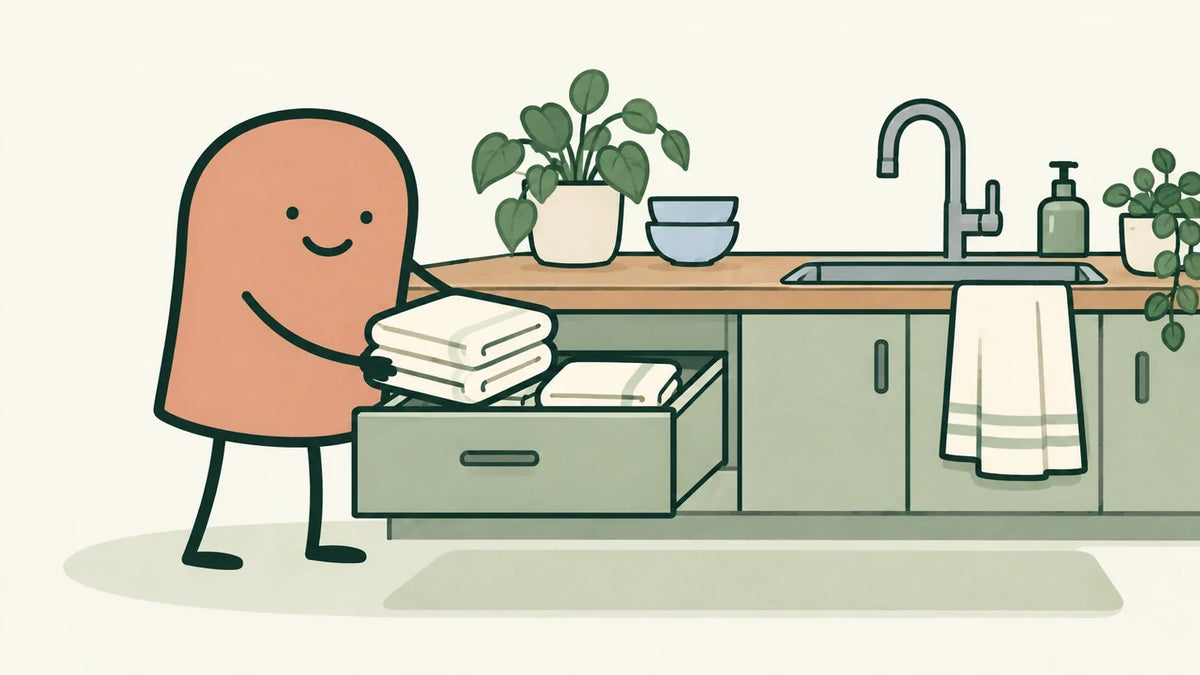
Consider this fictional example. Maya normally puts clean kitchen towels in a drawer, then returns later to replace the used towel by the sink. She tries replacing the used towel while she is already putting the clean towels away. Both tasks were happening before. The experiment is whether doing them together removes a separate trip.
She does not add a kitchen reset, wipe every cabinet, or reorganize the drawer. Those may be worthwhile jobs, but they do not belong inside this test. The stopping point is visible: clean towels stored, used towel replaced, finished.
A sensible pair usually shares supplies, location, or a natural transition. If the second task requires moving to another room, finding equipment, and interrupting someone else, the connection may look cleaner on paper than it feels in use.
Keep a missing first step from canceling everything
A chain can become fragile when every action depends on all the earlier ones. If the first action does not happen, the rest seem to disappear too. This matters when routines differ between weekdays, weekends, and days away from home.
For your two existing tasks, ask: if the first one is unnecessary today, does the second still need to happen? Maya does not put away clean towels every day. Replacing a used towel remains possible when needed; it has not become forbidden outside the pair. The new order is convenient when available, not an exclusive rule.
If you are actually introducing one new action and need to choose its starting signal, use our guide to choosing a cue you will notice. That is a different decision from rearranging two established tasks.
Use an end point, not an expanding checklist
Before trying the pair, finish this sentence: “I am done when…” Make the answer observable. “The towel is replaced” is clearer than “the kitchen feels organized.” The second wording can quietly invite ten more jobs.
If another task comes to mind, let it stay separate. A useful sequence should not automatically become the place where every unfinished household task lands. After a few ordinary opportunities, consider whether the pairing reduced effort, created rushing, or made either action harder to complete.
This is especially relevant in shared spaces. Moving your own tasks is one thing; changing someone else's usual order requires a conversation. A pair that works for you can still block another person from using the drawer, counter, or supplies.
What the research supports, and what this test cannot prove
Gardner, Rebar, and Lally's paper on studying habit formation describes habit in terms of learned relationships between contexts and responses. It does not establish that longer stacks are better or that the towel example will create an automatic habit. Treat the rearrangement here as a practical experiment in organization.
In One Thing at a Time, page 49 asks you to define the action, its existing moment, its honest duration, and its smaller version. It also explains that focusing on one priority is a design choice. You do not need to turn every existing task into a new project to use that approach.
Try one pair and leave the rest alone
Choose one pair, define its ending, and try it when the situation occurs naturally. Keep your other routines as they are. If the sequence adds friction, separate the tasks again. That is information about the arrangement, not a failed personal transformation.
For a broader plan, fit one action into the week you actually have. The complete One Thing at a Time guide connects these decisions through Watch, Choose, Plan, Shrink, Note, and Review, with a structured path and reusable tools.