
How to Choose a Habit Cue You Will Actually Notice
Compare two possible habit cues by checking whether they occur, stand out, and leave room to act. Give one chosen action a usable starting moment.
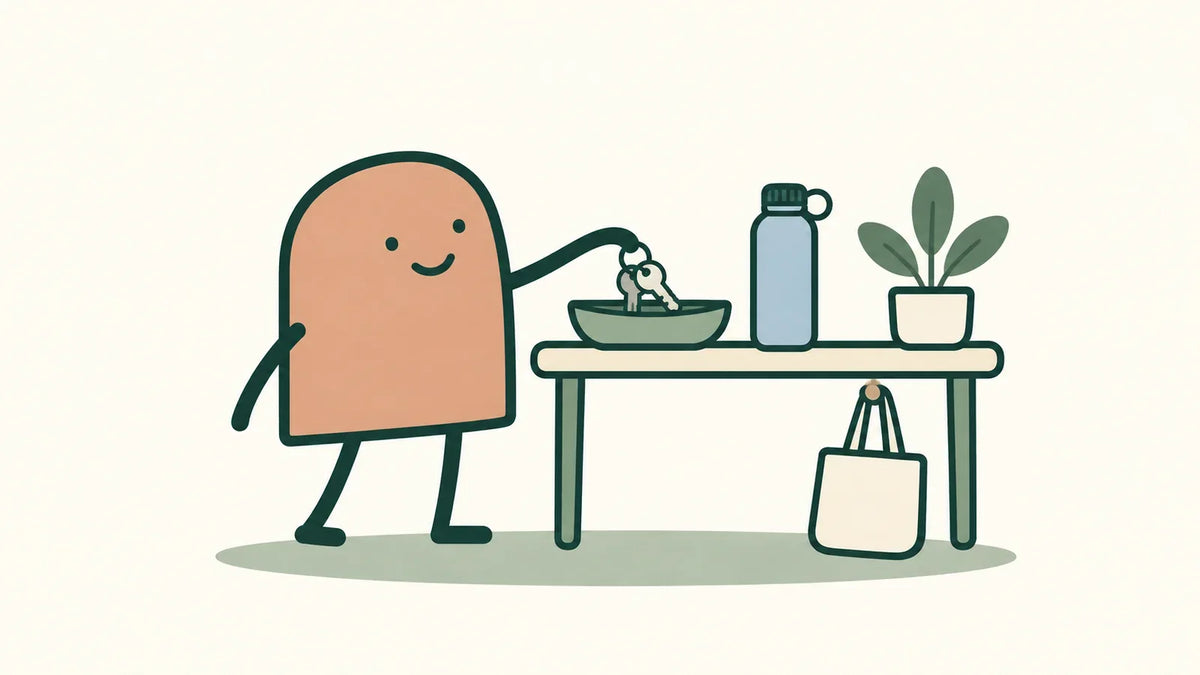
Choose a habit cue that already happens on the relevant days, has a recognizable moment, and leaves you a realistic opportunity to act. Compare two possible cues against those conditions, then connect one to the action you have chosen. A reminder is useful only if the moment it points to is usable.
You might know exactly what you want to do and still reach the evening thinking, “I forgot again.” Before adding another alert, look at the moment you expected the action to begin. Was that moment clear enough to recognize in the first place?
Start with the action the cue is meant to prompt
A cue needs a specific job. “After breakfast, I will get organized” leaves the response open. “After breakfast, I will put today's appointment card in my bag” identifies an action you could recognize and finish.
Choose the action before searching for its cue. Otherwise, an appealing morning routine can quietly acquire several new tasks. If you are still deciding what deserves your attention, begin with choosing your first habit.
For this article, work with one chosen action. You are deciding where it belongs, not adding another priority.
Compare two cues with three questions
Think of two moments that could reasonably come before your action. Then check each one.
Does it actually occur? “After my morning coffee” is a weak candidate if you often skip coffee or buy it after leaving the place where the action needs to happen. Describe your actual pattern rather than an ideal version of the morning.
Would I recognize the moment? “When work settles down” can remain vague for hours. “After I put away my work headset at the end of my shift” identifies an event. Make sure the wording matches what you really do.
Can I respond then? A cue can be clear and still arrive at an unsuitable moment. Hearing an alert while driving does not create a safe opportunity to write a note. A household handoff may require your full attention. Choose a different opening rather than expecting the cue to override those demands.
You do not need a point system. One clear reason a cue will not fit can be enough to rule it out.
Should you use a time or an existing routine?
A time can make sense when the same window is regularly available. An event can make sense when its clock time varies but the event and the opportunity following it remain recognizable.
Neither category automatically wins. In a randomized study of 192 adults choosing a nutrition behavior, researchers found no statistically detectable difference between routine-based and time-based cue groups. This does not prove the two are equivalent or identify the best cue for your situation. Read Keller and colleagues' study.
Use that uncertainty practically: compare the candidates in your own day. If 7:30 p.m. often falls during travel, dinner, or a caregiving task, its precision on a calendar is not enough. If “after dinner” varies between home and somewhere else, that event also needs a closer look.
A cue comparison before the first attempt
The following example is fictional, not a customer testimonial.
Leslie wants to read two pages of a personal book on evenings at home. The two candidate cues are a 7:00 p.m. phone alert and sitting down in a familiar chair after putting away the dinner dishes.
At 7:00 p.m., Leslie is often still handling dinner. The chair comes later, at a variable time, but is usually available on the evenings chosen for reading. Leslie keeps the book nearby and tries the chair cue on those evenings.
The choice is based on availability, not a claim that event cues are better. If another household member normally uses the chair then, or Leslie rarely sits there, the comparison would lead to a different decision. The useful cue belongs to the actual setting.
Leslie writes: “On evenings at home, after I sit in the chair following dinner cleanup, I will read two pages.” The sentence gives the action a recognizable occasion without adding several new commitments.
Use a reminder to point to the plan
If you want a reminder, make its wording specific enough to reconnect you with the chosen action. Put a paper note where you can appropriately see it or use a labeled alert at an available time. The reminder should fit your household, workplace, and attention needs.
Adding more reminders is not the only adjustment. If the moment is suitable but the object you need is elsewhere, remove that practical setup obstacle. If the whole action will not fit, consider a smaller useful version. A louder alert cannot create missing materials or extra time.
Write the occasion and try it
Complete this sentence: “On ___, after or when ___, I will ___.” Specify the relevant days or situations. Keep the cue concrete and the action bounded.
At the next suitable occasion, notice whether that pairing is usable. If your schedule does not yet offer an opening, leave the action unscheduled until you can choose one honestly. You do not need to call every unplanned day a missed habit.
In the book, the ordinary cue belongs on the Action Card. The separate If–Then card is for a prepared response to an obstacle you have actually encountered. You can choose your first cue without inventing problems to fill another worksheet.
Let one intention have a place to begin
Forgetting an intention can be frustrating. Giving it a recognizable, usable moment is one practical thing you can try. One Thing at a Time brings that decision into a complete method with one priority, a smaller version, notes, and review.
The book contains the full method. Private companion articles are being developed to add deeper explanation and practice; access follows the offer shown on the site.
