
A Simple Morning Routine Without Waking Up Earlier
You do not have to start with an earlier alarm. Look at the morning you already have and make one recurring transition easier to handle.
Read the articleYour week is the starting point.
Illustrative characters. Age is a browsing choice, not a diagnosis or a rule about you.
 Opening page…
THE BEYOND30 JOURNAL
A little perspective. A practical next step. Explore ideas for the everyday life you want to build.
Showing articles about Avoid An Overloaded Morning. Clear filter
You do not have to start with an earlier alarm. Look at the morning you already have and make one recurring transition easier to handle.
Read the article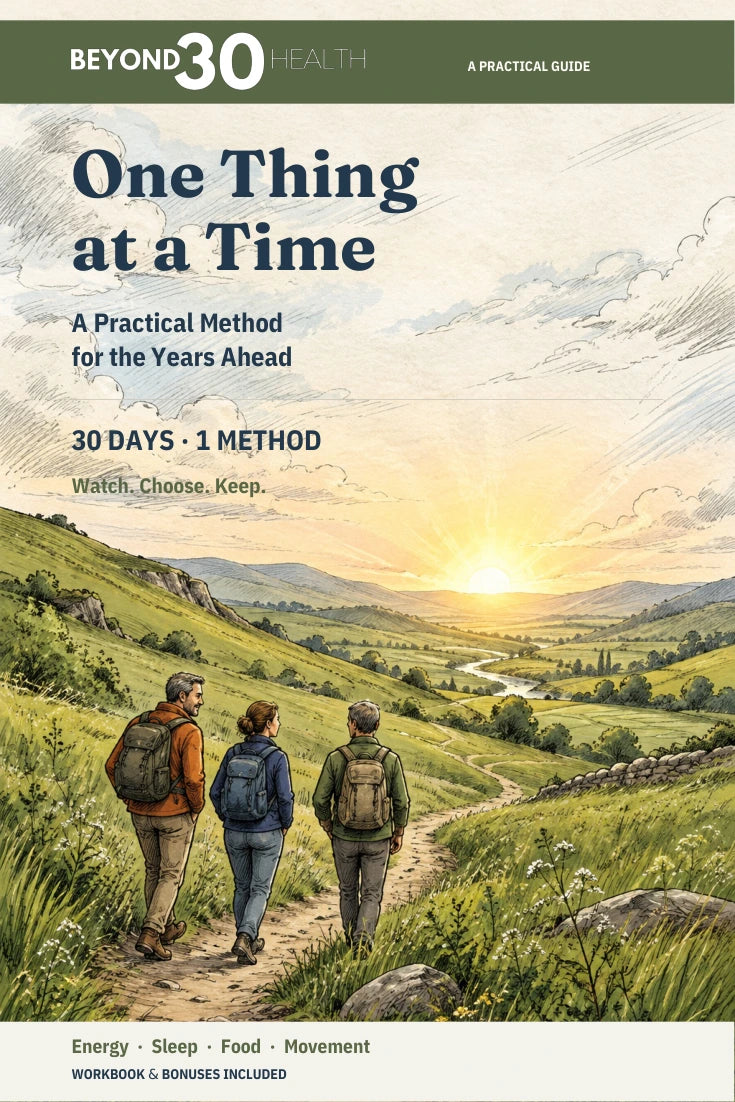
ONE SMALL STEP. YOUR OWN PACE.
Explore One Thing at a Time: a guided, reusable PDF for choosing a priority and making it part of your day.
Phone, tablet, computer , or print. Use it in the way that fits your life.
See the guideRegular price $69.99
$29.99
· One-time purchase
Available now · Included with your book
Understand all 336 pages with clear explanations and everyday examples, then ask us by email when a passage needs more clarity. Read from the beginning or go straight to a situation that matters to you.
Publisher’s estimated companion value $97 USD
Included with your book
Our value estimate, not a former selling price.
Every book page has its own guidance, with 580 fictional, illustrative situations across the companion. Connect an idea to everyday life, see alternatives and stop when you have enough clarity for your next step. Optional practice stays optional.
Each page gives you a direct way to email us about understanding the book, its worksheets or the companion material. This is educational clarification, not individual coaching or medical care.
Choose to bookmark a page, save your place in this browser or copy a page link to return later. Saved choices stay on this browser and device; they do not sync across devices or store your PDF answers.
After purchase, sign in to your reader account with the email address used at checkout. Shopify emails you a sign-in code; no password is needed.
Two years of companion access, starting when your access is activated. Your complete PDF is delivered after payment.
We update this companion alongside future book updates, with 12 months of guide updates included. Current readers receive the next improved book version without buying the book again and preferential offers on optional future extensions. Additional modules or companion books, if released, are separate optional purchases; their scope, price and release details will be announced separately.
Reader questions help shape clearer explanations and future resources. Community features remain proposals, not part of the current companion.
12 months of guide updates included. Keep your completed PDF when opening a new version; your answers do not automatically migrate.
A simple way to begin
Give one useful idea a place in your real week. The guide combines explanations with fillable pages you can save, revisit and use again.
Keep the untouched PDF, then add your name and notes in a copy opened with a PDF reader that supports fillable forms.
Use the clickable contents to find a topic that matters now. Read the explanation, then write one action on its working page.
Save, close and reopen the file to confirm your answers are there. Make a fresh copy when you want a clean worksheet.
The guide provides explanations and tools for observation, planning and review. It does not diagnose or treat a condition, prescribe a diet or exercise program, or replace a qualified healthcare professional.
New, unusual, worsening, persistent or concerning symptoms deserve appropriate professional advice. Email support concerns the guide, not individualized medical care.
Related books, courses and apps differ in content, format and scope. Their prices are not a valuation of this guide or an equivalent bundle. The comparison notes identify the published sources and the date checked without sending you to another site.
16 real sample pages. No email needed to explore.
You do not need another reading assignment. Explore how an explanation becomes a page for your own decisions, notes and next step.

01 / 06 · Watch
A vague feeling becomes easier to work with when you can describe one ordinary moment. Start with what happened, where you were and what came before it.
An example you could write
At 10:30 p.m., I was still replying to emails at the kitchen table.
Write one moment and its setting. Keep your first note to one or two lines.
Your starting pagesDay map · p. 262. Method overview · pp. 18 to 21.

02 / 06 · Choose
Good advice can pull you in several directions. Choosing one priority helps you decide which explanation and working page deserve your attention today.
An example you could write
My priority is to give the evening a clearer finish.
Name one priority and one reason it matters to your actual week.
Your starting pagesPriority card · p. 268. Choosing a starting point · p. 47.

03 / 06 · Plan
An intention still needs a practical opening. Connect one action to a moment you already recognize and decide what you will actually do when it arrives.
An example you could write
After I clear the dinner dishes, I will write tomorrow’s first task on one line.
Write the cue, the action and the time it can realistically take.
Your starting pagesAction card · p. 269. If-then card · p. 270.

04 / 06 · Shrink
A busy day should not leave you with only the full routine or nothing. Decide on a smaller useful version while you have time to think.
An example you could write
On a late evening, I will write only the name of the first task.
Keep the same cue and reduce the action to something manageable.
Your starting pagesAction card · p. 269. Bad-day plan · p. 275.

05 / 06 · Note
Memory can blur a busy week. A short record gives you something specific to review: what happened, what helped and what got in the way.
An example you could write
Tuesday: wrote the task after dinner. Wednesday: meeting ran late; no note.
Record what happened while it is fresh. Leave a gap when you did not make a note.
Your starting pagesHabit log · p. 271. Self-observation · pp. 124 to 125.

06 / 06 · Review
Use the notes to judge whether the plan fit your life. Keep what worked in practice, change what nearly fit and set aside what added unnecessary work.
An example you could write
Keep the after-dinner cue. Shorten the note. Drop the extra checklist.
Choose one thing to keep, one adjustment to try and anything you can set aside.
Your starting pagesWeekly review · p. 276. Simplified routine · p. 279.